
The Ghosts that Haunt Us
An analysis of horror and addiction in Stephen King's The Shining and Doctor Sleep

It’s 1992. I am twenty years old. Me and the boys have just played a game of football at 9am on a Saturday morning. Eleven-a-side. It was hard going, but we won. We head to the pub for many pints to celebrate. The next thing I know I wake up in bed, with blood all over my pillow, a large cut on my face and no memory of how I got there.
My relationship with alcohol has always been complicated.
To my existing subscribers and followers who have previously read my thoughts on various books and movies including IT, Salem’s Lot and Pet Sematary, thanks for coming back once again to my ramblings. For any readers new to these ruminations, welcome.
As you can possibly tell from the paragraphs above, these articles are never just a review of the film or novel in question, but more an analysis of why the story and characters resonate with me in so many different ways.
This week I’m going to be talking about Stephen King’s, The Shining in all it’s different iterations. From the novel that was published in 1977, to the famous Kubrick adaptation in 1980, and not forgetting the 1997 Mick Garris TV miniseries. I’ll also look at the sequel, Doctor Sleep, and how Mike Flanagan turned one of King’s worst novels into a great movie.
This near fifty year old book is often considered by many to be King’s best. However, as much as I admire its mostly single location setting and narrative of slowly building dread, it has always left me feeling somewhat distant. Looking back now, with the benefit of age and (a very small amount) wisdom, I think the word I should have been using was uncomfortable.
As I’ve said many times before, you bring who you are, and how you think, to any book or film. The upbringing you had, the memories you treasure and the life experiences gathered across the decades, all inform your opinion on these pieces of art.
This is why The Shining will never be amongst my favourite King novels. It’s far too close to the bone.
Anyway, before we get into all that, and for those who might not know, let me give a brief summary about what this story is all about.
Jack Torrance is a writer and a teacher. He is married to Wendy, and they have five year old son called Danny.
He is also an alcoholic.
In the early part of the book we learn that Jack has always had problems with his drinking but it recently got to such a level that, in fits of rage, he broke his son’s arm and also got fired from his role at a private school after assaulting one of the pupils.
His friend manages to get him a job as caretaker of the Overlook hotel in the Colorado mountains for five months during the winter. He will be joined by his wife and son.
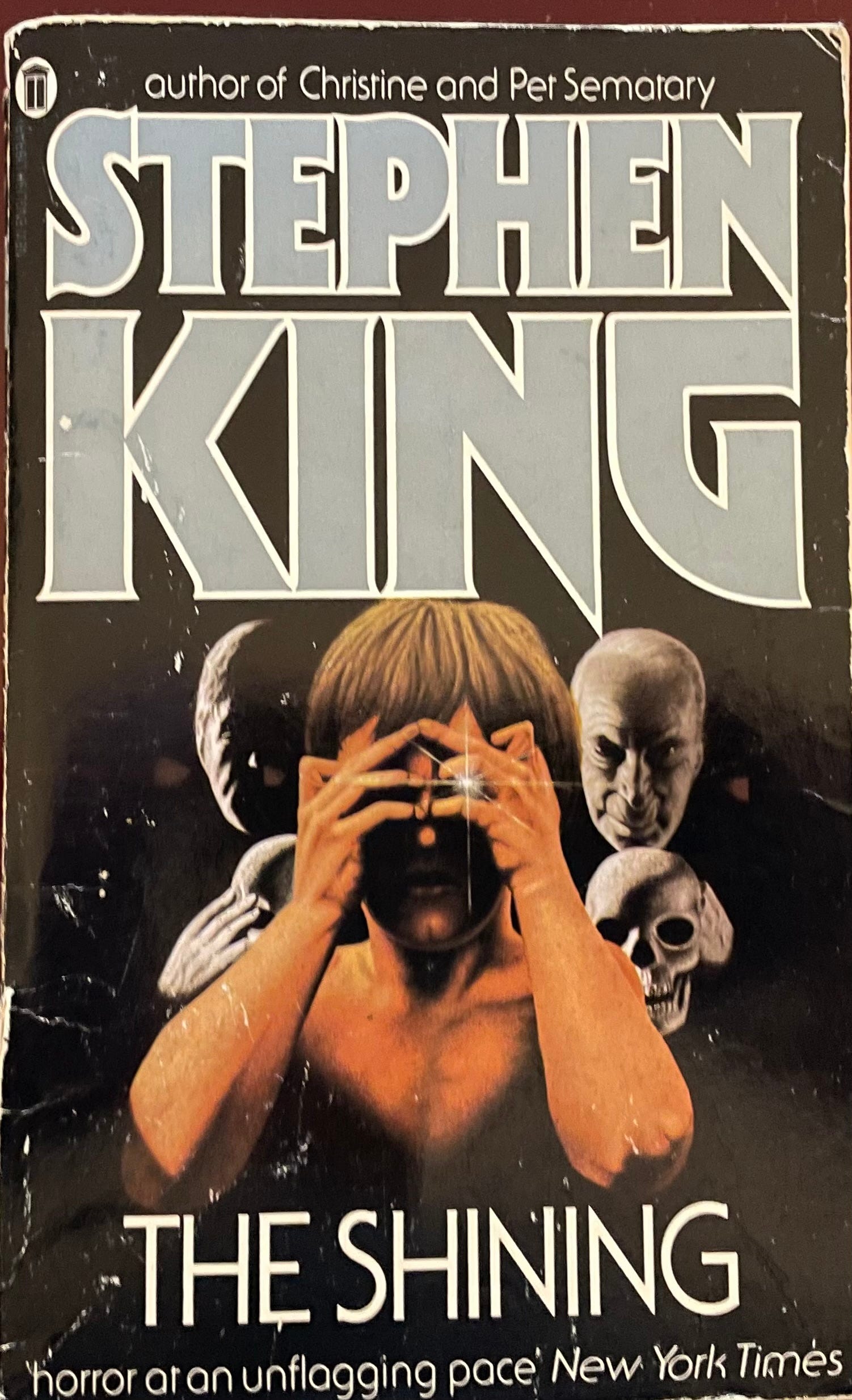
We find all this out in the first one hundred pages of the book, which are told from the perspective of the three main characters. So we see Jack’s self loathing for his addiction and the harm, both physical and mental, that he has imposed on his family, as he struggles with trying to stay sober. Wendy is someone who loves her husband, but also fears his outbursts of anger. And Danny has a very special power that he tries to hide from his parents as he struggles to understand the visions his “invisible” friend Tony shows him of supposed future events that will happen to him and his family. He can also sense what his parents are feeling at any given time, and if his dad wants to do the “bad thing” by start drinking again.
Within the first few chapters, there are also hints of the darkness to come. Ullman, the Overlook’s manager, tells the story of the last caretaker, Grady, who came to the hotel with his family and murdered them all. Here, rather than sympathise with the victims, Jack feels sorry for Grady being isolated and going slowly mad. It is an apt foreshadowing of his own future.
It’s fair to say that Jack is already a difficult character to like in these early parts of the book. When I was younger and first read what he had done to his son, I felt he was already irredeemable. In many ways I still think that. Any adult who lifts a hand to their child should be ashamed. But, looking at it now, you see that he already feels endless shame and anguish for what he did.
What I think is equally important, which I’ll come back to when looking at the film, is how all of these damaged people have their own agency.
Many of the chapters are told from Wendy’s perspective. She is a complex character with family issues from her own past weighing on her mind. And also, randomly, a strange obsession with cannibalism (!), which was clearly something King was reading about whilst writing the novel.
She worries about Jack and Danny, whilst battling feelings of jealousy at the close relationship they have, despite what her husband did to her son. Then, as they are getting shown the hotel kitchen by the chef, Dick Halloran, she picks up the strange connection that Danny has with him. It’s a connection that will save their lives, but for now she doesn’t understand it.
Dick is the first one to explain to Danny that his visions come from “the Shine.” A strange power that means he can read people’s minds, see certain things and be aware of what’s about to occur. He also warns him that there is something in the hotel that will be drawn to his power, especially in room 217, but that it can’t hurt him if he just looks away.
However, when Ullman gives the family a final tour of the the grand bedrooms, and they get to the presidential suite, Danny sees dried blood and brains splattered all over the wall. He looks away and the gore has gone, but as the door is closing, he notices that it’s back and this time the blood is fresh. So now he’s not sure if what Halloran told him is actually true.
The stage is set for what is to come.
“He was still an alcoholic, always would be …. It had nothing to do with will power, or the morality of drinking, or the weakness, or strength of his own character. There was a broken switch somewhere inside …”
Even before whatever resides in the Overlook begins to get hold of him, it is clear that not only is Jack an alcoholic but he has, and always has had, a terrible temper. This is what had got him fired from his last job and it begins to gradually drip back to the surface in his interactions with Wendy and Danny.
And yet, in these last remaining chapters before the horrors really begin, we get glimpses of a happy family making the best of their new surroundings. On every read, despite their problems, it makes you hope, despite what you know is coming, that things might actually work out for them.
But that was never going to be the case.
And things very quickly take a turn for the terrifying.
“This inhuman place makes human monsters.”
Finding a wasps nest in the roof seems to be the catalyst. It shows that Jack is beginning to be unsure of his memory and actions.
Did he use the bug bomb correctly to kill all the wasps? If so, how did they come back and sting Danny? Then, not long after, he finds himself down in the basement for hours reading up on the hotel’s history, desperate for a drink, and frantically rubbing his lips until they start to bleed.
Danny’s visions have started to get more creepy and disturbing with a visit to the doctor, very similar to the scene with Regan/Captain Howdy in The Exorcist, not providing any answers.
In the middle of all of this is Wendy who is swiftly realising that being trapped in the Overlook for the next five months, completely snowbound, might not be the best thing for her family, never mind her sanity.
It’s not only Danny that’s seeing things now. As Jack wanders around the topiary, the hedge animals begin to hunt him. Unsure if he is hallucinating, he runs back to the hotel where he finds an empty bar now full of bottles and a barman, Lloyd, waiting to take his order. Things are beginning to fall apart.
“Of course. The manager.”” Lloyd’s smiled broadened, but his eyes were socketed in shadow and his skin was horribly white, like the skin of a corpse. “Later he expects to see to your son’s wellbeing himself. He is very interested in your son. Danny is a talented boy.”
Despite Halloran’s warnings, Danny visits room 217 and is attacked by the woman in the bathtub. Now he knows these things can hurt him. However, Wendy initially blames Jack and drives him further into a dark cloud of rage.
It’s not until the final one hundred pages of the novel when all the things that everyone remembers come to pass. Up until then, it’s been a exquisitely slow build up of tension and creeping dread.
The elevators, full of party streamers, banging between floors in the middle of the night, Wendy and Danny hearing music and voices whilst Jack spends more and more time in the basement and (empty) bar that is populated by ghosts from the hotel’s past.
“You’re the caretaker, sir,” Grady said mildly. “You’ve always been the caretaker. I should know, sir. I’ve always been here.”
Both of these spectres seem to be implying to Jack that the “manager” is the hotel itself. With that in mind, are we to believe that the building is somehow a living evil entity rather than just bricks and mortar that are haunted by traumatic events from the past? And, if that’s the case, why would it desire the gift of Danny’s Shining? Does it simply need it to entrap and corrupt more of the residents? Is it a portal to hell, drawing all these conflicted souls like moths to a flame? Or, in fact is the Overlook the devil himself, somehow requiring this power to escape from the confines of a prison in which it finds itself? And, if so, who trapped it there? This is all wild speculation of course, and I can find no corroborating evidence one way or another from King, but it makes for an interesting theory. It certainly puts the Overlook up there, along with Pennywise, as one of the author’s great supremely powerful villains.
“If they got out of here, the Overlook might subside to its semi-sentient state, able to do no more than present penny-dreadful horror slides to the more psychically aware guests who entered it. Without Danny it was not much more than an amusement park haunted house …..But if it absorbed Danny …into itself ….what would it be then?”
Either way, Jack gets drunk in a dry bar, on alcohol that shouldn’t exist, and is convinced by Grady to “correct” Wendy and Danny for all the grief they have supposedly brought into his life.
However, in focusing on this, the hotel has forgotten something very important that will be come back to bite them later on.
At the end, when the entity that’s controlling Jack is hunting down his son with the roque mallet, the flawed, but still kind man he once was, forces his way back to the surface one final time.
“ …but suddenly his daddy was there, looking at him in mortal agony, and a sorrow so great that Danny’s heart flamed within his chest. The mouth drew down in a quivering bow.
““Doc,”” Jack Torrance said. ““Run away. Quick. And remember how much I love you.””
At the last minute, Danny and Wendy, with the help of Halloran, do manage to escape before an almighty explosion tears the Overlook apart and kills Jack.
I would like to think that the old Jack, the human one, the man who loved his family, had done it on purpose. That somewhere within all the spite and hate that the hotel had put in his mind, was the knowledge that if he didn’t control the temperature on the boiler then it was going to explode and destroy the Overlook once and for all. So, when he could feel the creep of evil invading his thoughts, he had let the boiler pressure increase until it couldn’t be stopped.
You see, to King, struggling as he was with his own addictions, this was always an autobiographical story on the destructive power of alcohol and the fear that it could make you harm someone you loved. These were issues that King clearly understood and sympathised with.
And, I guess, ultimately this is why I still find the book so tough to read.
My father was an alcoholic.
He wasn’t haunted by anything supernatural, but rather the ghosts of his past. Hurt, regret, frustration and shame. His own father, who we affectionately called Papa when we were kids, remorselessly beat my dad when he was growing up, as he was the one who stood up to the old bully when he tried to hit my Nana or his brothers and sisters. My Papa used to be a boxer so he knew where to hit to make it hurt.
Then, when he was 39, the Pilot boat my dad was working on exploded, throwing him onto the pier, badly burning his back and causing injuries that would give him chronic pain for the rest of his life. However, at the time, he didn’t care about that and went back on board to rescue the other boatman who would have died if not for his actions.
It may not have been monsters that caused my dad’s death but rather the inescapable darkness of the bottle that took him down a path from which there was no return. He tried many times to give up, but these physical and mental strains, as well as this terrible, relentless addiction, always dragged him back, causing him to lose jobs and, ultimately, himself.
However, even despite all the pain and trauma he carried, my dad was never violent with us, no matter how much he drank. Yes, he could lose his temper on occasion with voices raised and doors slammed, but that was as far as it ever went. He was a good man, brought low by things out of his control.
My dad was just 72 when he died. I went to visit him in hospital, not long before he passed, when he was suffering from kidney failure. We would talk a while and then he would ask me if I could see spiders and other creatures crawling up the hospital walls, convinced that they were there and not just a common side effect of the build up of toxins in the blood stream due to his condition. It was as tragic as it was chilling.
I have spoken many times of the love I feel for my father and this book, when I read it as a teenager, as tough as it was, in many ways helped me understand the destructive force that is alcoholism. As the previous quote says, it’s not down to lack of willpower, but of something being broken inside. My dad tried his best to fix it, but in the end, despite his best efforts, he just couldn’t manage to get there.
Jack can’t escape his internal and external demons either. But, when the love for his family finally wins through, he makes the ultimate sacrifice.
And that’s just one of the reasons why I dislike the Kubrick movie so much.
There’s already been a lot written as to why Stephen King hated the adaptation, so I’m not going to just repeat them here. However, I did just watch the movie again last night and all the same problems I’ve always had with it are still there.
Yes, Nicholson’s casting is all wrong, but that’s not the problem with him. The main issue is that there’s quite literally nothing there. No characterisation at all. This is a good man brought low by the hotel. But we don’t get to see that. He is just a sypher for the axe carrying psycho he’ll become.
His descent into madness is way too fast. Literally within 20 minutes he doing that blank stare out the window and the maniacal laugh that we know so well.
Also, there’s never any explanation for why the bar being fully stocked is actually such a big thing. His alcoholism, and the temptation that the hotel makes it, isn’t really mentioned. Sure there are a couple of lines about him being “on the wagon” but they seem throwaway and inconsequential. His assault on Danny, and any regret he feels, totally skirted over and marginalised.
The music! For the love of God, the music is so annoying. Whenever anything dramatic or supposedly scary is going to happen or has just happened, here it comes. Parp! Parp! Parp! Parp! Be scared! Look at all this blood pouring out of these elevator door in slow motion. Oh look, there’s two little spooky girls, oh now they’re murdered, oh now Danny is making that shaky little face again.
Like I’ve mentioned previously, Wendy is one of three main characters in the book, but here she is just a shrill, weeping victim. And this isn’t me looking on it with modern eyes. It was a ridiculous performance, (and one specifically requested and extracted by Kubrick’s brutal methods), even forty five years ago.
There is absolutely no heart or emotion in the film whatsoever. Nothing to show the love that Jack feels for his family or they for him. So when he begins to lose his grip on sanity it doesn’t actually matter. They are NPC’s wandering around a fake funfair waiting for spooky things to start happening. And, when it does all kick off, we’re meant to be terrified? Why? We don’t care about these people so why should their fate bother us? It is a completely hollow experience. All surface thrills and nothing else.
On this re-watch, I don’t think I just disliked the film, I think it actively infuriated me. It’s like this was the first attempt at doing that most hated of things, “elevated horror.” It thinks it’s somehow special because it’s got all these artfully shot scenes that are trying to tell us something profound above the already strong enough source material. Absolute nonsense.
In fact, I would go as far to say, it’s not actually an adaptation of Stephen King’s The Shining, it’s just a horror movie that Stanley Kubrick made in which the characters have the same names as in the novel.
The scariest movie ever? Give me a break.
The Mick Garris TV mini series, on the other hand, which King wrote so he could get his version on screen, is a well intentioned curiosity with some spooky moments and decent performances by Steven Weber as a non-gurning Jack and Rebecca De Mornay playing a much stronger Wendy. Still nowhere near as effective as the book, with its TV origins are on show a wee bit, but I still had a far greater emotional connection to it than for its more illustrious predecessor.
When it was first shown on TV in 1997 it got decent viewing figures and a mixed reception. However, a year after, on the book tour for Bag of Bones, King was asked whatever happened to Danny Torrance, and a seed was planted.
It took until 2013 for Doctor Sleep to be published. And, to be honest, it really wasn’t worth the wait.
The story begins not long after the events at the Overlook with the opening chapter perfectly capturing the tone and terror of the original as Danny finds the woman from room 217 in the bathroom of the small house he is sharing with his mum. It’s incredibly creepy and promises great things to come.
We then cut to a grown up Dan who is struggling with familiar problems, having turned to alcohol and drugs to blot out his childhood memories and try to dampen down the Shine. He is an angry man who gets into fights and steals money to feed his addictions.
Halloran has died and Dan is all alone trying to battle his demons, but he still remembers the advice the old man gave to him about how he can lock away the ghosts of the Overlook in his mind.
“Maybe you can put those things from the Overlook away in lockboxes, but not memories. Never those. They’re the real ghosts.”
It’s an interesting set up which the novel doesn’t really follow through on. The curse of passing down addictions from parents to children is explored, but the story is in too much of a rush to get to the main plot about the True Knot, a group of travelling vampire-like creatures who hunt children with the Shine and consume their powers. And that part I just found incredibly dull and uninvolving.
Yes, the chapters in the care home are touching and heartfelt, but I still think it’s one of King’s weakest novels with a hugely unsatisfying ending.
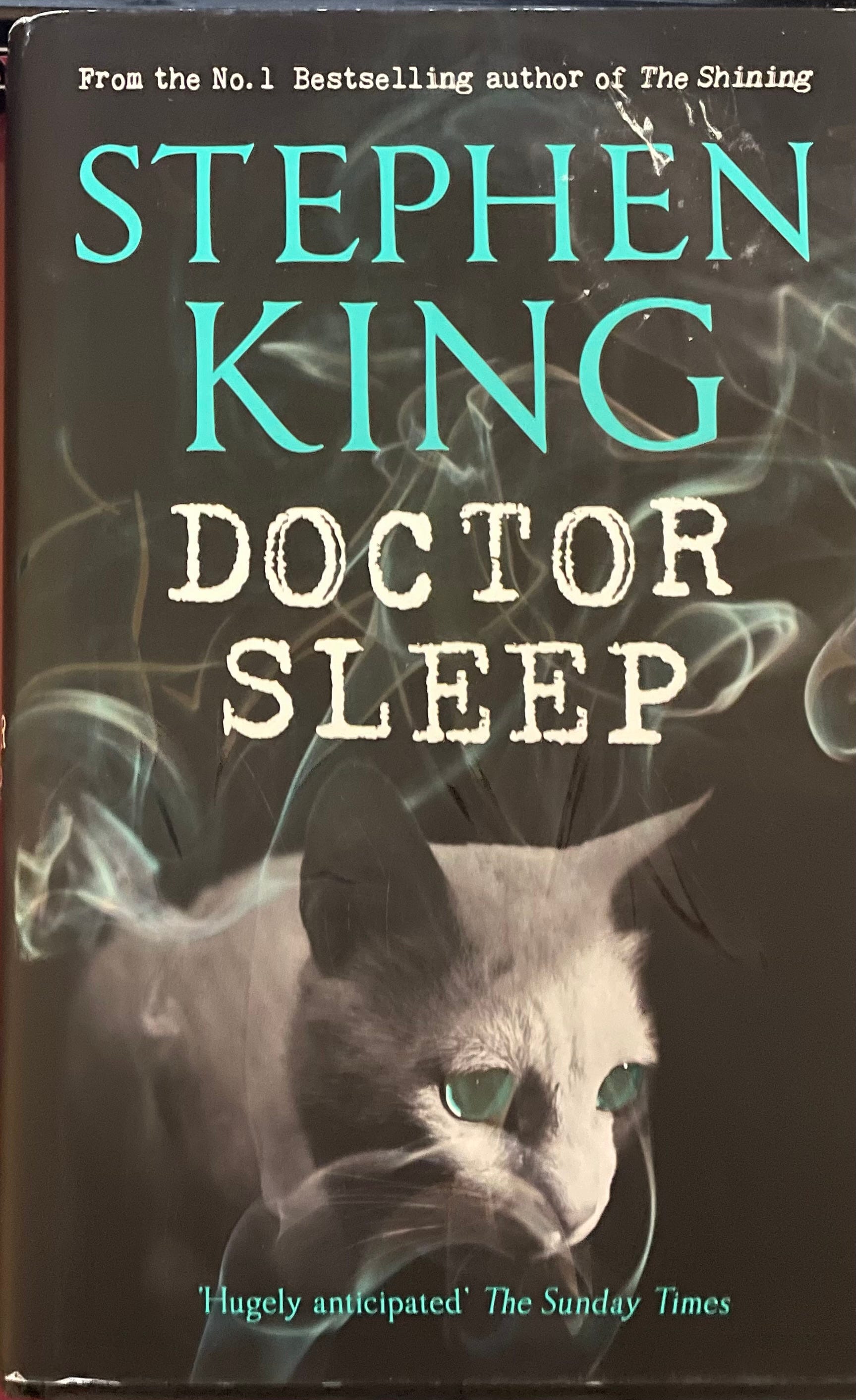
However, in 2019, Mike Flannagan who had managed to make a brilliant adaptation of the supposedly unfilmable Gerald’s Game, directed the screen adaptation of Doctor Sleep and, by finding a bridge between The Shining novel, this book and the Kubrick adaptation, made something far darker and more profound than anyone could ever have imagined. It is a brilliant contemplation of addiction, death and forgiveness.
Being a recovering alcoholic himself, Flannagan felt a deep connection to the material and managed to create that most rare of things, an adaptation of a Stephen King novel that is far better than the source.
Here he really leans into the desperation Dan is feeling, turning the money stealing scene into something particularly disturbing and grim. And yet, he also takes the time to show the friendship and support that is available through AA to conquer your addictions and give hope in the darkest times. Yes, the Abra and True Knot stuff is still a bit boring, but Rebecca Ferguson is good value as Rose the Hat and Ewan McGregor brings an authentic weariness to the role of Dan, even managing to put on a decent impersonation of Nicholson’s accent from the original movie.
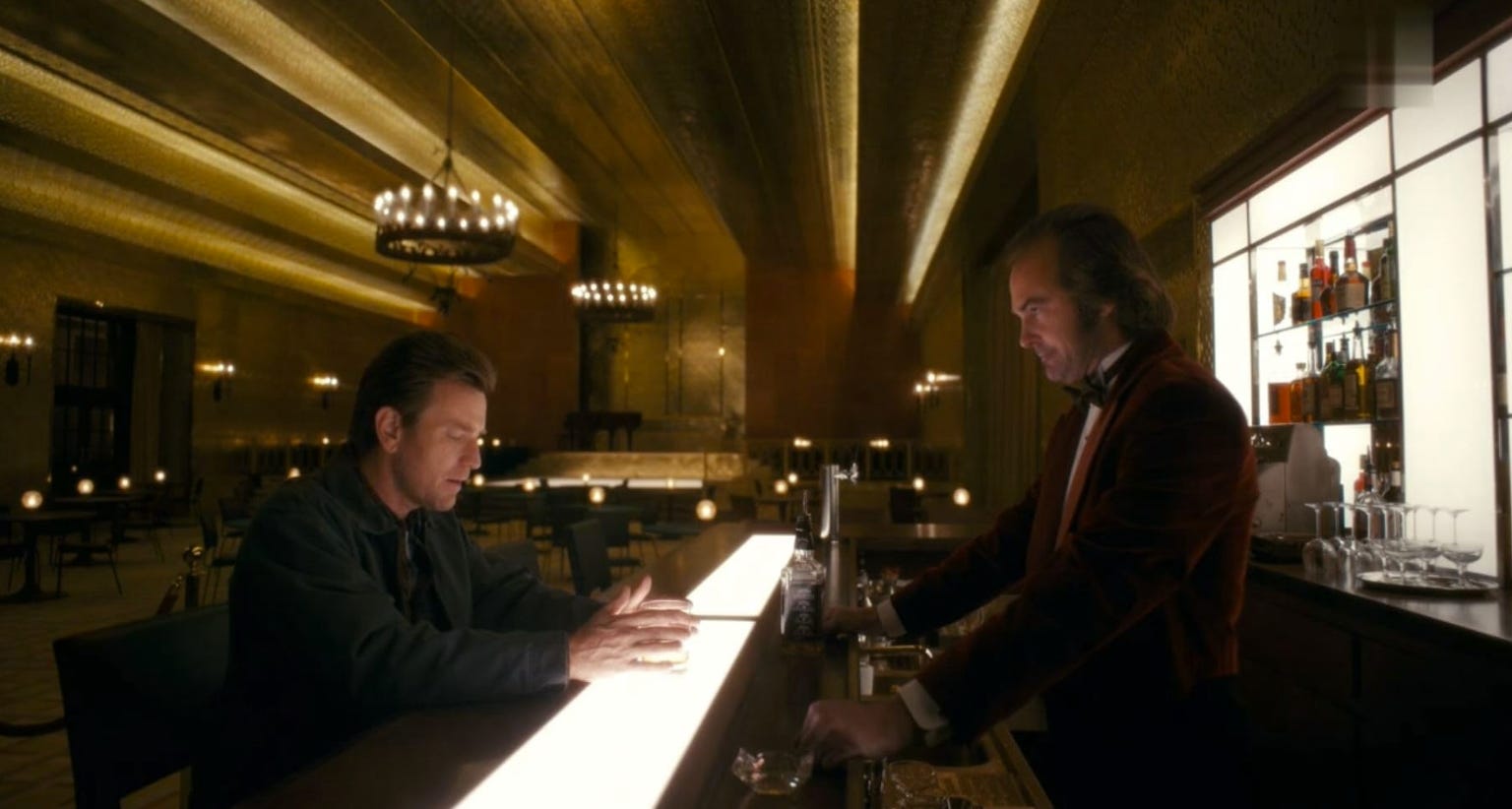
King had initially objected to Flannagan having any references to Kubrick’s film in this one or indeed bringing back the Overlook in any form, but the author finally relented when he read the script. It was a wise choice. The scene between Dan and the ghost of his father, in the Gold Ballroom, where Jack tries to offer his recovering alcoholic son a drink, perfectly encapsulates the “sins of the father” overarching narrative and is perfectly played. Whatever the Overlook is, it knows that the same breakage, passed down from father to son, exists within Dan, despite his Shine, and is trying to exploit it to gain his power.
Addiction can be genetic. There are a lot of other environmental and lifestyle factors that obviously come into play, but studies have shown if you have a family history of addiction you are more like to suffer from it yourself.
Dan fights back against the temptation of the hotel and the conclusion of Doctor Sleep shows that, once more, due to his sacrifice, the good angels win out. However, I’m mature enough to know, in real life, that’s not always the case.
As for myself, I am aware of my past, and my upbringing, but try every day to forge my own path.
When both my parents passed away within three years of each other, I turned to the comforting fog of forgetfulness that only drink can bring. It took me a while to find my way back out, but I got there through the help of family and friends.
Those excesses and the mistakes of my drunken youth, and what made me indulge them, are long behind me. The fear of addiction, passed down from father to son, doesn’t apply to me. Or so I tell myself.
When I’m with my mates, I am a social drinker. Having fun, enjoying their company and setting the world to rights as only old friends can do. Never having too much.
However, on those rare occasions when my wife is travelling on business, and my son is living away at university, there are nights when I can be sitting alone, having a beer, and I feel something creep up on me. Like a far away call. The voice of my own Overlook? Tempting me to drink everything that’s in the house. To chase down whatever is broken within me with the sweet excess of oblivion.
But I don’t do it.
I think of my dad. The man who dragged his friend from a burning boat, who stood up against the brutish monster of his past with heart and courage. A kind man who loved his family, who cherished what time he had, telling all those wonderful stories that I still carry with me, and who helped me become the person I am today. That’s how I remember him. Not someone forged by their addiction, but as a father, friend and inspiration.
And those memories soon dispel the dangerous spectres of temptation.
We know that dreams are hard to come by, and sometimes you have to fight through nightmares to get to them.
A dream of being happy. Of being settled in your own body and soul. Understanding your place in the world. Using whatever power you have as a light against seemingly overwhelming darkness that can come from both without and within.
These brilliant stories are indelible lessons in bravery.
To not be afraid. To hope. To love. To Shine.
Thanks for reading.
Until next time.
This is a terrifically thoughtful, personal, touching and insightful piece Daniel. Thanks for sharing. I really enjoyed it especially as a big King fan. Although The Shining is one I haven't read.
I'd love to read something similar about The Stand, the 1994 mini series and the new adaptation. I've read the book now and watched the very flawed but admirable attempt of the '94 version. Just trying to track down the 2020 version despite its poor reviews.
I absolutely agree with your statement, "... I would go as far to say, it’s not actually an adaptation of Stephen King’s The Shining, it’s just a horror movie that Stanley Kubrick made in which the characters have the same names as in the novel." Such miscasting and such poor direction! Kubrick totally missed the point. I like that you interweave your own father's story into this review; a reader's background absolutely affects the interpretation of a story. As writers, we never know how our stories will be taken in and understood.